

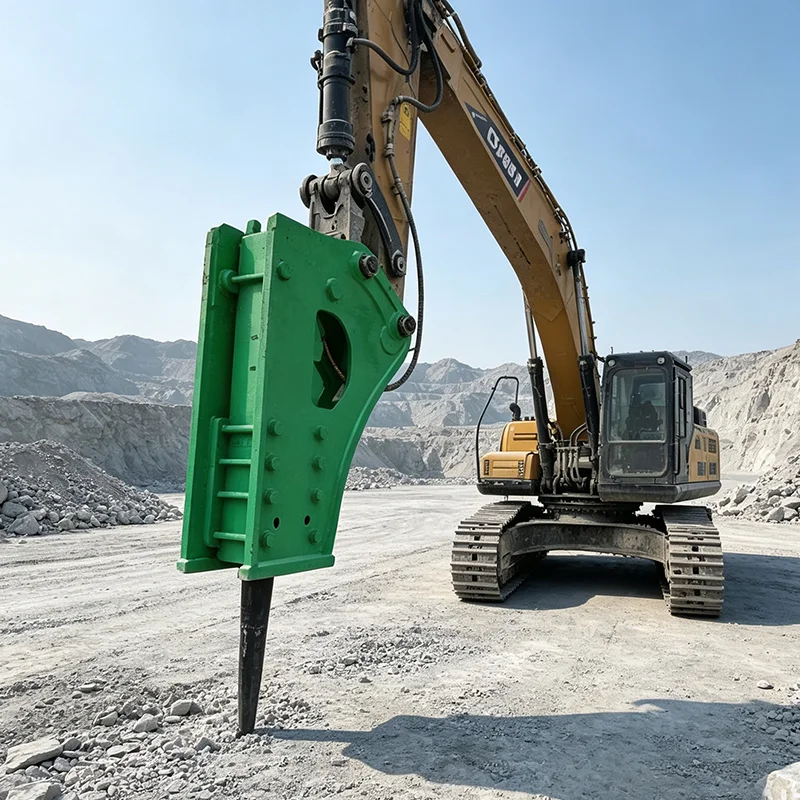
Chisel Type Determines What You Can Break
The most important decision when buying a hydraulic breaker is choosing the right chisel (tool) for the material you will break. The wrong chisel shape will either bounce off hard rock or chew through soft concrete, wasting energy and wearing out quickly.
Moil point (narrow, tapered point) is the most versatile chisel. It concentrates all the impact energy into a small point, making it ideal for breaking medium-hard rock, reinforced concrete, and asphalt. The moil point penetrates the surface first, creating cracks that propagate outward with each blow. It is the default choice for general-purpose demolition where you break mixed materials.
Blunt tool (wide, flat end) is designed for breaking very hard rock and large concrete chunks. The wide flat end delivers energy over a larger area, crushing rather than penetrating. It works best on non-reinforced concrete, boulders, and hard rock. Blunt tools are also preferred for secondary breaking — reducing large boulders to sizes suitable for a crusher bucket.
Wedge chisel (flat, blade-shaped) is designed for horizontal and vertical breaking of slabs, walls, and asphalt. The wedge shape splits material along natural planes — perfect for breaking concrete pavements, foundation walls, and rock in excavation. Wedge tools wear faster than moil points because the cutting edge concentrates stress.
Impact Energy and Carrier Weight: Matching Breaker to Excavator
Breakers are rated by impact energy (joules) and by carrier weight class. The general rule: the breaker should weigh 10–15% of the excavator operating weight. A breaker that is too heavy will overload the boom and hydraulics, causing premature pump failure. A breaker that is too light will underperform — you spend all day tapping at material that a properly sized breaker would finish in hours.
For reference: a 1–3 ton mini excavator pairs with a 100–300 kg breaker delivering 200–600 J per blow. A 5–8 ton excavator uses a 500–800 kg breaker with 1,000–2,500 J. A 20–25 ton excavator typically runs a 1,500–2,500 kg breaker delivering 5,000–10,000 J. Blow frequency (BPM) matters too — a breaker delivering 5,000 J at 400 BPM breaks more material than one delivering 6,000 J at 200 BPM.
Hydraulic Flow and Pressure: The Hidden Performance Killer
The second most common mistake is mismatching the breaker hydraulic requirements to the excavator auxiliary circuit. Every breaker specifies a required oil flow (L/min) and operating pressure (bar). If your excavator delivers too little flow, the breaker runs at reduced blow energy and slow cycle rate. If too much flow, you overheat the breaker, cook the seals, and shorten diaphragm life in the accumulator.
Maintenance That Doubles Breaker Life
The average breaker fails not from the piston or the front head, but from lack of bushing lubrication and letting dust enter the tool chamber. Grease the tool bushings every 2 hours of operation. Dry bushings wear in weeks; properly greased bushings last 1,000–2,000 hours. Never fire the breaker into empty air — blank firing sends shock waves back through the front head and can crack the through-bolts.