

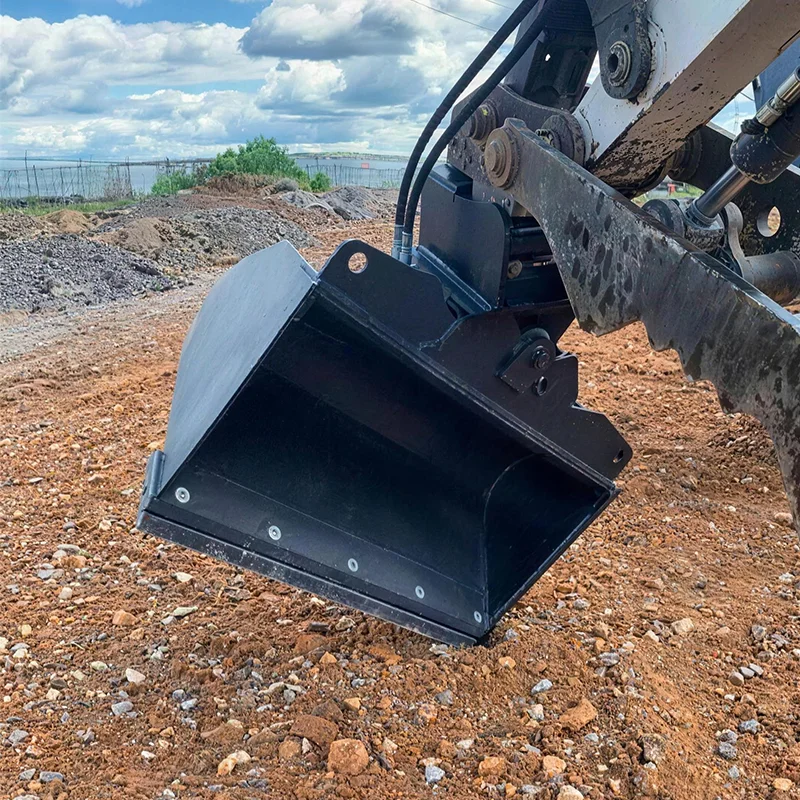
Tilting Bucket: Swing Angle, Cut Depth and How It Works on Slopes
A tilting bucket (also called an angle bucket or ditch cleaning bucket with tilt) is a standard digging bucket mounted on a rotary bracket that swings left and right by a hydraulic cylinder. Most models tilt up to 45 degrees in each direction, giving a total swing of 90 degrees. The operator grades, trims ditches, and cuts slopes without repositioning the excavator — a huge time saver on finishing work where a standard bucket would force repeated repositioning.
Tilting buckets are the standard attachment for road grading, ditch cleaning, slope shaping, and landscaping finish work. A wider bucket (1500–2400 mm) with a flat bottom and side cutters is preferred for grading; a narrower bucket (600–1000 mm) works for ditches. The tilt bracket usually uses two hardened steel pivot bearings and a hydraulic cylinder with adjustable tilt lock.
Why Tilting Beats a Standard Bucket on Finish Work
On a roadside grading job, a standard bucket forces the operator to swing the whole excavator to follow the slope line. A tilting bucket lets the operator hold the bucket at the exact slope angle and walk along the trench, cutting a clean grade in one pass. Contractors report 30–50% faster finish grading and 60% less hand trimming by laborers.
On a hillside landscaping project, an operator used a 1800 mm tilting bucket on a 13-ton excavator to cut a 3:1 slope over 200 meters of drainage ditch. The bucket held the 18-degree angle continuously, and the finished slope was ready for hydroseeding without hand finishing — saving two days of labor.
Choosing the Right Tilting Bucket
Match the bucket width to your excavator and job: for a 6–10 ton excavator, a 1200–1500 mm bucket covers light grading and ditch work. For a 13–20 ton excavator, a 1800–2400 mm bucket is the standard grading width. Check the tilt cylinder pressure (usually 14–20 MPa) and confirm your auxiliary hydraulic circuit can supply it. Most tilting buckets need 40–80 L/min of auxiliary flow — smaller than a breaker, so they work on almost any excavator with one auxiliary line.
Maintenance That Prevents Slack
The most common failure is a sloppy tilt bracket caused by worn pivot bushings. Inspect the pivot pins every 100 hours for play; worn bushings make the bucket drift off angle mid-cut. Grease the tilt cylinder rod end and pivot pins every 10 hours of operation. Check the cutting edge and side cutters weekly — a worn cutting edge loses the flat grading surface that makes the bucket accurate.