

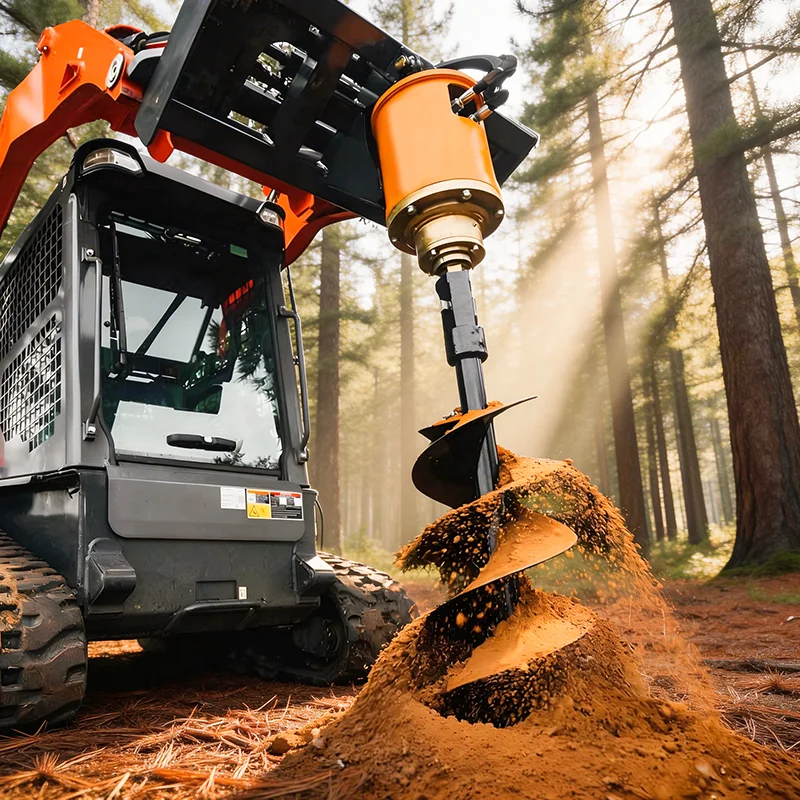
Flight Pitch and Diameter: How Soil Moves Up the Auger
The auger flight — the spiral steel blade welded to the central pipe — is what moves soil out of the hole. Two parameters determine how efficiently: flight diameter and flight pitch. Diameter sets the hole size; pitch sets how much soil is lifted per rotation.
Standard pitch augers have a pitch equal to about 70–80% of the flight diameter. They lift a moderate volume of soil per rotation and work well in most conditions — sand, loam, and light clay. They are the default choice for fence posts, tree planting, and general utility holes.
Short pitch augers (pitch = 40–50% of diameter) bite more aggressively and hold soil more tightly, making them better for rocky ground and compacted soil. The trade-off: slower extraction and more chance of jamming in wet clay.
Torque Rating: Matching Auger Drive to Excavator Flow
Earth augers are driven by a hydraulic planetary gearbox at the top, which converts high flow and low pressure into high torque at low RPM. The drive unit is rated by torque (N·m) and required hydraulic flow (L/min). A 1–3 ton mini excavator pairs with a 500–800 N·m auger drive; a 5–8 ton excavator uses a 1,500–3,000 N·m drive; a 20-ton excavator can handle a 5,000–8,000 N·m drive for foundation piers.
Digging Speed in Real Conditions
In loose loam or sand, a 300 mm auger on a 5-ton excavator digs a 1.2 m deep hole in 20–30 seconds. In compacted clay, the same hole takes 60–90 seconds. In weathered rock, digging slows to 3–5 minutes per hole, and you may need a rock auger with carbide teeth.
On a recent fence installation project, a contractor used a 6-ton excavator with a 200 mm auger to drill 350 fence post holes at 1.2 m depth, averaging 45 seconds per hole — roughly 80 holes per hour.
Maintenance That Prevents Premature Failure
The most common auger failure is not worn teeth but a leaking drive unit caused by bent or misaligned mounting. Always bolt the auger drive to the quick coupler with the provided brackets. Grease the gearbox every 50–100 hours, and inspect flights for cracks after rocky jobs.